Migratory Birds

Nolan O'Connor
| 19-03-2026
 · Animal Team
Watching flocks of birds sweep across the sky can feel like witnessing a live GPS in action.
How do they travel thousands of miles without a map or compass? The secret lies in a mix of biology, memory, and environmental cues that guide their journeys with astonishing precision.
Using the Sun and Stars
Birds are natural navigators, relying heavily on celestial cues. During the day, the sun provides a consistent reference point, and birds can compensate for its movement using an internal clock. At night, many species turn to stars, recognizing patterns in the constellations.
Practical insight:
Birds like warblers and thrushes memorize star positions to orient themselves.
Experiments have shown that when starlight is blocked, nocturnal migrants become disoriented, demonstrating their reliance on celestial navigation.
Young birds practice these routes under parental guidance, learning which stars indicate the correct direction.
Observing this, you can see that even in overcast conditions, migratory birds combine visual cues with other senses to maintain their course.
Magnetic Field Detection
One of the most fascinating navigation tools birds use is the Earth's magnetic field. Certain cells in the eyes and brain contain magnetoreceptors that detect field lines, allowing birds to “feel” their position relative to the planet's magnetic poles.
Examples in action:
Pigeons have been documented returning to their home lofts from hundreds of kilometers away using magnetic cues.
Some species adjust their flight angle based on magnetic inclination, which provides latitude information.
In controlled studies, altering magnetic fields causes birds to deviate from their normal migratory path, confirming this natural GPS system.
This magnetic sense complements other navigation strategies, ensuring birds stay on track even when visual cues are limited.
Landmarks and Environmental Memory
Birds don't rely solely on invisible forces—they also memorize physical landmarks. Rivers, coastlines, mountain ranges, and even urban structures serve as reference points during long migrations.
How it works:
Geese often follow river valleys or mountain chains that act as natural highways.
Birds repeatedly migrating along the same route refine their memory of specific stopover points for food and rest.
Young migratory birds learn these paths by following experienced adults, combining instinct with observation.
This spatial memory reduces the risk of getting lost and allows birds to make quick course corrections if they encounter bad weather or obstacles.
Social and Group Navigation
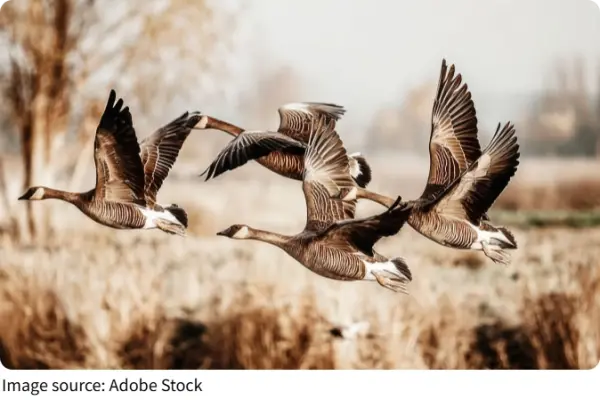
Migratory birds often travel in flocks, where group dynamics aid navigation. Experienced birds lead, and their decisions help correct errors or inefficiencies in the route. Flying in formation also conserves energy, which is crucial for long-distance travel.
Insights from flocking behavior:
Geese flying in a V-formation communicate through subtle wing movements to maintain alignment.
Birds may adjust their speed and direction collectively, guided by leaders who know the optimal route.
This social learning helps younger or less experienced birds stay on course without solely relying on innate navigation skills.
Group travel demonstrates that migration is a combination of biology, learning, and teamwork, all working in harmony.
Takeaway for Observers
Next time you watch a flock passing overhead, think about the hidden toolkit each bird carries: an internal clock, magnetic sensors, environmental memory, and social guidance.
Their journeys reveal the incredible ways life adapts to survive, inspiring us to pay attention to patterns, preparation, and cooperation—whether navigating cities or continents. Even without GPS, these birds exemplify precision, endurance, and teamwork that humans can learn from.